How to ask for a pay rise without sounding awkward
Hate feeling underpaid but freeze up when you think about asking for more? You worry you'll sound pushy, awkward, or just get a flat "no." The problem isn't your performance. It's not having the right words.

Hate feeling underpaid but freeze up when you think about asking for more? You worry you'll sound pushy, awkward, or just get a flat "no." The problem isn't your performance. It's not having the right words.
This guide gives you the words. It starts with a clear script, then shows you how to back it up with numbers, salary research, and a smart follow-up if the answer is no. For those looking to broaden their professional horizons beyond salary, exploring career development resources can provide a stronger foundation for these high-stakes conversations.
Use This Core Script to Ask for a Pay Rise Today
This is your base script. Start here, then adjust it to your manager and situation.
Plug-and-Play Script for a Standard Pay Rise Conversation
- Set up the meeting
- Email/Chat: "Hi [Manager's Name], do you have 15 to 20 minutes next week to discuss my career growth and compensation?"
- Email/Chat: "Hi [Manager's Name], I'd like to book a short meeting to review my progress and discuss my salary. When works for you?"
- Open the meeting
- "Thanks for making the time. I'd like to talk about my compensation."
- "I appreciate you meeting with me. I want to discuss my role, my contributions, and my salary."
- Present your value with numbers
- "Over the past year, my work has had a clear impact. For example, I led the [Project Name] project, which increased customer retention by 15%. I also streamlined our reporting process, saving the team about 5 hours per week."
- "These results show the value I'm bringing to the team."
- Show your market value
- "I've researched salary data on Glassdoor and LinkedIn Salaries, plus [Third Source]. For my role, experience, and location, the market range is between £[X] and £[Y]."
- "My current salary of £[Your Salary] is below that range, especially given my recent results."
- Make a clear ask
- "Based on my performance and the market data, I am asking for a new salary of £[Target Salary]."
- "This would better reflect my work and the current market rate for my role."
- Invite their response
- "How does that sound to you?"
- "What are your thoughts on this?"
Example “Core” Script (Word-for-Word)
"Hi [Manager's Name], thanks for meeting with me. I’m committed to my role here and I really value the work we do.
I wanted to talk about my compensation. Over the last 12 months, I’ve taken the lead on several key projects. My work on the [Project Name] project helped reduce customer churn by 12%, and I automated the [Specific Task], which now saves the team around 4 hours a week.
I checked market rates for a [Your Role] with my experience in [Your City]. Based on three salary data sources, the range is between £[X] and £[Y]. My current salary is below that range.
Considering my results and the market data, I’m requesting a new salary of £[Target Number]. This would better reflect my contributions and the value I bring to the company.
What are your thoughts?"
Quick Table: What to Say at Each Stage
| Stage | Exact words you can use |
|---|---|
| Ask for meeting | "Can we meet to discuss my compensation and career path?" |
| Open the talk | "Thanks for your time. I'd like to talk about my salary." |
| Show value | "My work on [Project] delivered [Metric]. I also saved [Time/Money]." |
| Make ask | "Based on my results and market data, I am asking for £[Target Salary]." |
| Handle reaction | "I understand. What would need to happen for this to be possible?" |
| Close | "Thank you. Can we agree on a date to revisit this?" |
Tune Your Script to Different Manager Types
Not all managers are the same. Use the script that fits yours best.
Script for a Supportive Mentor Manager
"Hi [Manager's Name], thanks for meeting. I really appreciate your guidance over the past year, especially on [Project or Skill]. It’s helped me grow, and I feel I’m contributing at a higher level now.
My work on the [Project Name] led to [Positive Result], and I’ve taken on more responsibility with [New Task]. As I’ve stepped up, I want to make sure my compensation reflects that growth.
Based on my impact and market research, I’m looking for a salary of £[Target Salary]. I’d love to hear your thoughts and your advice on how we can make this happen."
Script for a Data-Driven, Analytical Manager
"Hi [Manager's Name], thanks for meeting. I wanted to discuss my compensation and have prepared a business case to support it.
In the last six months, I have delivered three key results: I increased [Metric A] by [Number]%, reduced [Metric B] by [Number]%, and completed [Project C], which led to [Outcome].
According to market data from three sources, the salary band for my role is between £[X] and £[Y]. My current salary is in the lower quartile.
Based on my performance metrics and this data, I am requesting a salary adjustment to £[Target Salary]. I have the full details here for you to review. What are your initial thoughts?"
Script for a Very Busy, Time-Poor Manager
"Hi [Manager's Name], thanks for your time. I know you’re busy, so I’ll keep this short. I’d like to discuss my compensation.
Over the past year, I’ve hit all my targets, including [One Major Achievement]. Based on my performance and market rates, I am requesting a salary of £[Target Salary].
I’ve prepared a one-page summary with my key achievements and the supporting data if you’d like to see it. Is this something you can consider?"
Script for a Conflict-Avoidant or Vague Manager
"Hi [Manager's Name], thanks for meeting. I’d like to talk about my compensation. My work on [Project] resulted in [Metric], and I’ve also taken on the extra responsibility of [New Task].
Based on this added scope and my results, I am asking for a salary of £[Target Salary]. I wanted to get your direct feedback on that number.
If they deflect: "I appreciate that. To bring it back to my compensation, what are your thoughts on my request?"
If they say 'I’ll see': "Thanks. What does that process look like, and when can I expect an update? Can we set a follow-up for next week?"
Script for a Tough or Skeptical Manager
"Hi [Manager's Name], thanks for meeting. I’m here to discuss my salary.
This year, I delivered on three key objectives. I grew [Metric A] by [Number]%, which brought in £[Revenue]. I cut costs on [Process B] by [Number]%. And I led the [Project C] launch, which is now on track to exceed its goals. Market data shows a typical salary for this role and performance level is around £[Market Midpoint].
Based on these results, I am requesting a new salary of £[Target Salary]. I believe my documented performance justifies this adjustment and brings my pay in line with my value to the company.
What are your thoughts? If you see it differently, can you help me understand what specific results or metrics you would need to see from me to support this increase?"
Prep Like a Pro: What to Bring Into the Conversation
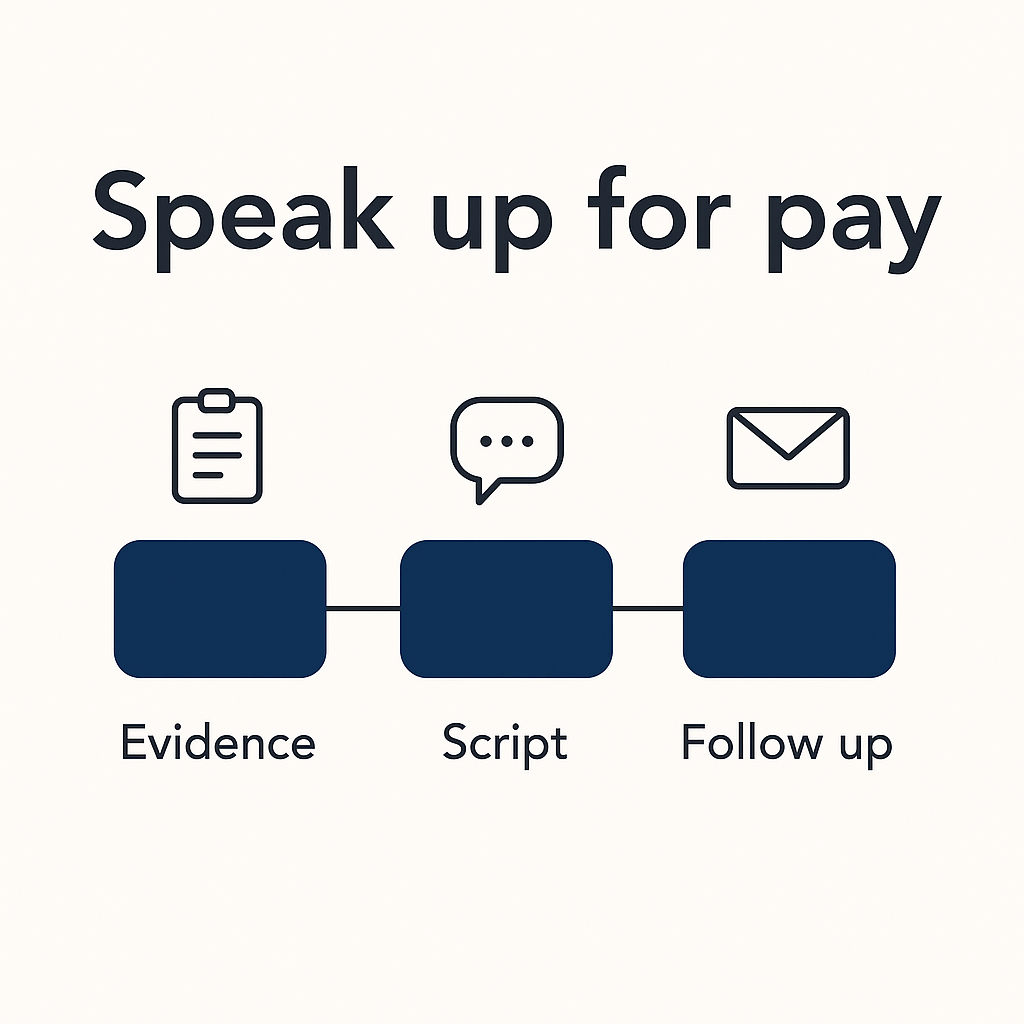
Don’t walk in empty-handed. Bring proof. Many universities provide a career development toolkit that can help you organize your achievements into a professional business case.
Collect Evidence That Backs Up Your Script
- List 3 to 5 STAR-style examples
STAR is a simple way to frame your wins: Situation, Task, Action, and Result.
- Example 1: I noticed our team was spending 10 hours a week on manual data entry. I was tasked with finding a fix. I built an automated script to pull the data instead. This cut the process to 30 minutes, saving over 9 hours of team time per week.
- Example 2: A key client was at risk of leaving. My goal was to retain them. I scheduled a meeting, identified their pain points, and created a new service plan. They renewed their £50,000 contract and gave us a positive testimonial.
- Example 3: Our project was behind schedule. I needed to get it back on track. I reprioritized tasks and coordinated with two other departments to clear blockers. We delivered the project on the revised deadline, avoiding a £10,000 penalty.
- Use metric-based proof
Good raise cases use this pattern: Metric + baseline + result + time period.
- "Reduced onboarding time for junior devs from 10 days to 6 days, saving 120 team hours per quarter."
- "Increased platform conversion rates from 2.1% to 3.5% through UI changes."
- "Improved system uptime from 99.0% to 99.9% over 12 months, reducing churn."
What Metrics to Include
Use numbers that show business value, not vague praise.
| Type of impact | Good example |
|---|---|
| Revenue | "Generated £35,000 in new business." |
| Efficiency | "Reduced deployment cycle time by 22%." |
| Cost | "Saved £18,000 a year through cloud optimisation." |
| Productivity | "Cut manual work by 8 hours a week." |
| Quality | "Lowered error rates from 6% to 1.5%." |
How to Format Your Numbers
Keep them short and easy to scan.
- Use one line per achievement
- Start with the result
- Add the baseline
- Add the time frame
- Add the business impact
Example format:
- Reduced bug backlog from 140 to 45 in 3 months, which sped up releases by 2 weeks.
- Increased monthly leads from 220 to 310 over 6 months, adding £28,000 in pipeline.
Add Salary Range + 3 Key Skills
Use at least three salary sources, like LinkedIn Salaries, Glassdoor, and UK salary boards, to find a solid range for your job title, experience, and location. Your target salary should be a specific number in that range that you can justify with your skills and recent work.
How to Use Glassdoor and LinkedIn Salaries
- Search your exact job title
- Use the same title you hold now, or the closest match.
- Avoid broad titles if your role is specialized.
- Match your location
- Search by city or region, such as London, Manchester, or remote UK.
- Salary can shift a lot by location.
- Match your experience level
- Compare your years of experience with the filters in the tool.
- If the site lets you filter by seniority, use it.
- Check base pay and total comp
- Some roles include bonus or equity.
- Separate base salary from total package so you know what you’re asking for.
- Compare at least three sources
- Look for a similar range across Glassdoor, LinkedIn Salaries, and another UK source.
- If one source is far off, treat it as less reliable.
- Spot premium skills
- If you have niche skills like AI, cyber security, or specialist DevOps work, adjust your target upward.
Quick Checklist Before You Speak Up
- Meeting with your manager is booked.
- 3 to 5 measurable wins are written down in metric form.
- Clear salary range and a specific target number are decided.
- Short script or bullet notes are ready.
- Your opening line is rehearsed once so it sounds natural.
Adjust Your Script to Your Situation
Your core script is a starting point. Adjust it to what’s happening at work.
When Your Responsibilities Have Quietly Expanded
"Hi [Manager's Name], I’d like to discuss my role and compensation. Over the past six months, my responsibilities have grown beyond my original job description. In addition to my core duties, I’m now responsible for [Responsibility 1], [Responsibility 2], and training new team members.
I’m happy to contribute, and my performance in these new areas has been strong, especially my work on [Project], which led to [Positive Result].
Since my role has changed so much, I’d like to discuss adjusting my salary to £[Target Salary] to reflect that scope. It would also be useful to talk about whether a new job title makes sense. What are your thoughts?"
When You Have a Strong Competing Job Offer
"Hi [Manager's Name], I want to talk to you about something important. I really value my role here and the work we do.
Recently, I was approached by another company and have been made an offer for a similar role at £[Offer Amount]. My first choice is to stay here and keep growing with the team. I believe my work on [Project 1] and [Project 2] shows my commitment and value.
To make staying here the right long-term decision for me, I would need a revised salary of £[Target Salary]. Would the company be able to match that to keep me on the team?"
When the Company Is Under Financial Pressure
"Hi [Manager's Name], I know budgets are tight right now, and I want to be fair to that. I’d still like to discuss my compensation and long-term growth.
Over the past year, my scope has expanded to include [New Duty], and my work on [Project] saved the company £[Amount]. My market research also shows my role is valued higher elsewhere.
I’m asking for my salary to be reviewed. If a base pay increase isn’t possible right now, could we look at other options? For example, a one-time bonus, extra paid time off, flexible or hybrid work, a training budget, or a formal date to revisit my salary in three to six months?"
Alternative Compensation Options to Propose
If the company cannot raise base pay, use total reward language and propose specific options.
| Option | Exact language to use |
|---|---|
| Stock options | "Could we discuss stock options so I can share in the company’s future growth?" |
| RSUs | "Could we look at restricted stock units that vest over time instead of a salary increase?" |
| Phantom stock | "Could a phantom stock plan be an option, so my reward tracks company value without issuing shares?" |
| Deferred compensation | "Could we structure deferred compensation to be paid at a later date?" |
| Performance bonus | "If base pay is frozen, could we agree a one-time bonus tied to my goals or company results?" |
| Flexible work | "Could we discuss flexible or hybrid work arrangements as part of the package?" |
| Additional PTO | "Could I receive extra paid time off instead of an immediate raise?" |
| Professional development | "Could the company fund training, tuition, or certifications such as AWS or Azure?" |
| Benefits / retirement | "Could we improve the package through higher retirement contributions or other non-cash benefits?" |
When You Haven’t Had a Formal Review for a Long Time
"Hi [Manager's Name], I’m booking this time because it’s been about [Number] months since my last formal performance review, and I’d like to discuss both my progress and my compensation.
Since our last review, I’ve taken on [New Responsibility] and delivered on several key projects, including [Project Name], which resulted in [Metric]. I feel my contributions and skills have grown during this time.
Based on this progress and market data for my role, I am requesting a salary adjustment to £[Target Salary]. I’d like to walk you through my achievements and get your feedback. Can we schedule a full review for next week?"
Handle Any Answer: Scripts for “Yes”, “Maybe”, and “No”
The conversation does not end when you make your ask. Be ready for any reply.
If They Say “Yes” or Agree in Principle
"That’s fantastic news. Thank you so much, I really appreciate it.
Just to confirm, the new salary will be £[Agreed Amount], effective from [Start Date]?
Is there any paperwork I need to complete on my end?"
If They Say “Maybe”, “Let Me Think”, or “I Need to Check Budget”
"I understand, thank you for considering it.
To help with your decision, is there any more information I can provide about my performance or the market data I found?
Could you let me know who else needs to be involved in the decision?
Can we set a date to follow up on this, perhaps this time next week?"
If They Say “No” Right Now
Use this exact response:
"Thanks for being direct with me and for considering my request. I’m disappointed, but I appreciate the feedback. Could you tell me what specifically I need to improve or achieve for us to revisit this, and when we should set the next review date?"
Then follow up with these questions:
- "Is this due to budget, timing, or performance?"
- "What specific goals would you need to see from me?"
- "What date should we revisit this?"
- "What would make a raise possible in the next review cycle?"
Immediate Follow-Up Actions After a “No”
- Ask for the main reason for the decline.
- Request measurable goals.
- Agree on a review date in 3 or 6 months.
- Send a recap email the same day.
Short One-Liners You Can Use in the Moment
- "Can you help me understand why?"
- "What would need to happen for this to be possible?"
- "Can we set a date to revisit this in the next quarter?"
- "Are there other compensation options we can look at, like a bonus or more paid time off?"
- "What timeline can I expect for a decision?"
- "What does the budget look like for the next quarter?"
The One-Page Summary Your Manager Can Actually Use
If your manager is busy, bring a one-page summary. Keep it short and easy to scan.
What to Include
| Section | What to add |
|---|---|
| Title | Your name, role, and date |
| Target request | Specific salary number or range |
| Market data | Low / median / high range from your research |
| Top achievements | 3 to 5 wins with numbers |
| Business impact | Revenue, cost saved, time saved, or quality gains |
| Supporting proof | Reviews, praise, or certifications |
Simple One-Page Layout
Name: [Your Name]
Role: [Job Title]
Current salary: £[Amount]
Target salary: £[Target Amount]
Market range: £[Low] – £[Median] – £[High]
Top achievements
- Reduced [Metric] from [Baseline] to [Result] in [Time Period].
- Generated £[Amount] in new business.
- Saved [Hours] hours per week by improving [Process].
- Improved [Outcome] by [Number]%.
Why this matters
- Scope has grown
- Results are above target
- Market pay is higher for this role and location
Support
- Performance review notes
- Client or peer feedback
- Relevant certification or rare skill
Follow Up in Writing: Email Templates After Your Meeting
Always send a follow-up email. It creates a paper trail and confirms what was discussed.
Follow-Up Email After a “Yes”
Subject: Following up on our conversation
Hi [Manager's Name],
Thank you again for meeting with me today to discuss my compensation.
I’m thrilled to accept the new salary of £[Agreed Amount], effective from [Start Date].
Please let me know if there's any paperwork I need to sign or any other steps I need to take to formalize this.
I’m excited to continue delivering great results for the team.
Best,
[Your Name]
Follow-Up Email When the Decision Is Pending
Subject: Following up on our conversation
Hi [Manager's Name],
Thanks again for taking the time to discuss my compensation today.
I appreciate you taking my request to review with [HR / Leadership / Finance]. I’ve attached a brief summary of my key achievements and the market data we discussed, in case it’s helpful.
Could you let me know what the expected timeline is for a decision?
Thanks,
[Your Name]
Follow-Up Email After a “No, Not Now”
Subject: Following up on our conversation
Hi [Manager's Name],
Thank you for your time and transparency in our meeting today.
While I’m disappointed that a salary increase isn't possible right now, I appreciate you explaining the reasons.
I am fully committed to my role and to reaching the next level. Per our conversation, I'd like to confirm the key goals for me to focus on are [Goal 1] and [Goal 2].
Can we schedule a check-in for [Date, e.g., 3 months from now] to review my progress and revisit this discussion?
Thanks,
[Your Name]
When to Send and How Often to Follow Up
- Send the first follow-up email the same day or the next morning.
- If the decision is pending, follow up once every 1 to 2 weeks for an update if you haven’t heard back.
- After a "no," send the recap email immediately and put the agreed revisit date in your own calendar.
Sound Confident, Not Awkward: Language Tweaks That Matter
How you say it is as important as what you say.
Swap Out Weak Phrases for Stronger Ones
| Avoid saying | Say instead |
|---|---|
| "I was just wondering if maybe…" | "I’d like to discuss my compensation." |
| "I feel like I deserve…" | "My results and market data support an increase." |
| "I'm sorry to ask, but..." | "Thanks for meeting. I want to talk about my salary." |
| "I think I've done a good job." | "I increased [Metric] by [Number]%." |
| "Is now a bad time?" | "When is a good time to discuss my career growth?" |
| "This might be a long shot, but…" | "I'm asking for a salary of £[Target Salary]." |
| "Some other people with my job get..." | "Market data shows the range for my role is..." |
Body Language and Tone Tips
Sit upright, keep your hands on the table, and make steady eye contact. Speak in a calm, even voice. If you get nervous, pause instead of filling the space with "um" or "like." Practice your opening line once or twice. In the meeting, keep your notes in front of you, but do not read them word for word.
When You Want Extra Help Before the Conversation
Practicing is the key to confidence. Specialized employment career resources can also offer templates and guidance for long-term career planning and advocacy.
Get Outside Coaching and Practice
It’s one thing to read a script, but another to say it under pressure. Practice your pitch with a trusted friend, mentor, or a professional coach. Saying the words out loud helps you spot where you stumble and builds confidence. For more structured guidance and practice, you can get dedicated pay rise coaching that walks you through each step of the process.
Use Expert Support for Tough Negotiations
If the stakes are high, like a large raise, a competing offer, or tricky internal politics, you do not have to do it alone. An expert can help you shape your argument and prepare for every likely response. For one-to-one help shaping your ask and responses, you can find focused salary negotiation support.
Quick Recap: Your Pay Rise Script, in 5 Simple Steps
- Prepare evidence and a clear target number. Gather your 3 to 5 biggest wins with metrics and research the market rate for your job.
- Use the core script that fits your manager type. Choose the script that matches your manager’s style.
- Adjust the script to your situation. Fine-tune your ask if your scope has grown, you have a competing offer, or the company is facing financial pressure.
- Handle “yes”, “maybe”, or “no” calmly. Know what to say next to confirm details or set a clear next step.
- Follow up in writing. Send an email to document the conversation and define the timeline for a decision or future review.
You have the words. You have the structure. Asking for a pay rise is a skill, not a personality trait. The more you prepare and practice, the easier it gets. Now, go get paid what you're worth.
FAQs
1. How do you respectfully ask for a pay rise?
Respectfully asking for a pay rise means grounding your request in facts, not feelings. Book a dedicated meeting, present your achievements with clear metrics, show market data that supports your request, and make a specific ask. Keep your tone professional, calm, and focused on the value you bring to the company.
2. Is a 20% raise crazy to ask for?
A 20% raise is not crazy if you can justify it. This size of increase is usually right when your responsibilities have grown a lot, you are well below market pay, or you have a competing offer. You need strong evidence of your performance and market value.
3. How do you ask for a raise without sounding demanding?
You avoid sounding demanding by using collaborative language and focusing on facts. Instead of saying "I deserve more money," say, "I’d like to discuss how my compensation aligns with my recent contributions and the market rate." Frame it as a business conversation about value.
4. What should you not say when asking for a raise?
Avoid emotional arguments like "I work so hard" or "I need the money." Don’t use threats or ultimatums. Avoid complaining about colleagues’ salaries. Stick to your own performance, your impact on the business, and objective market data.